




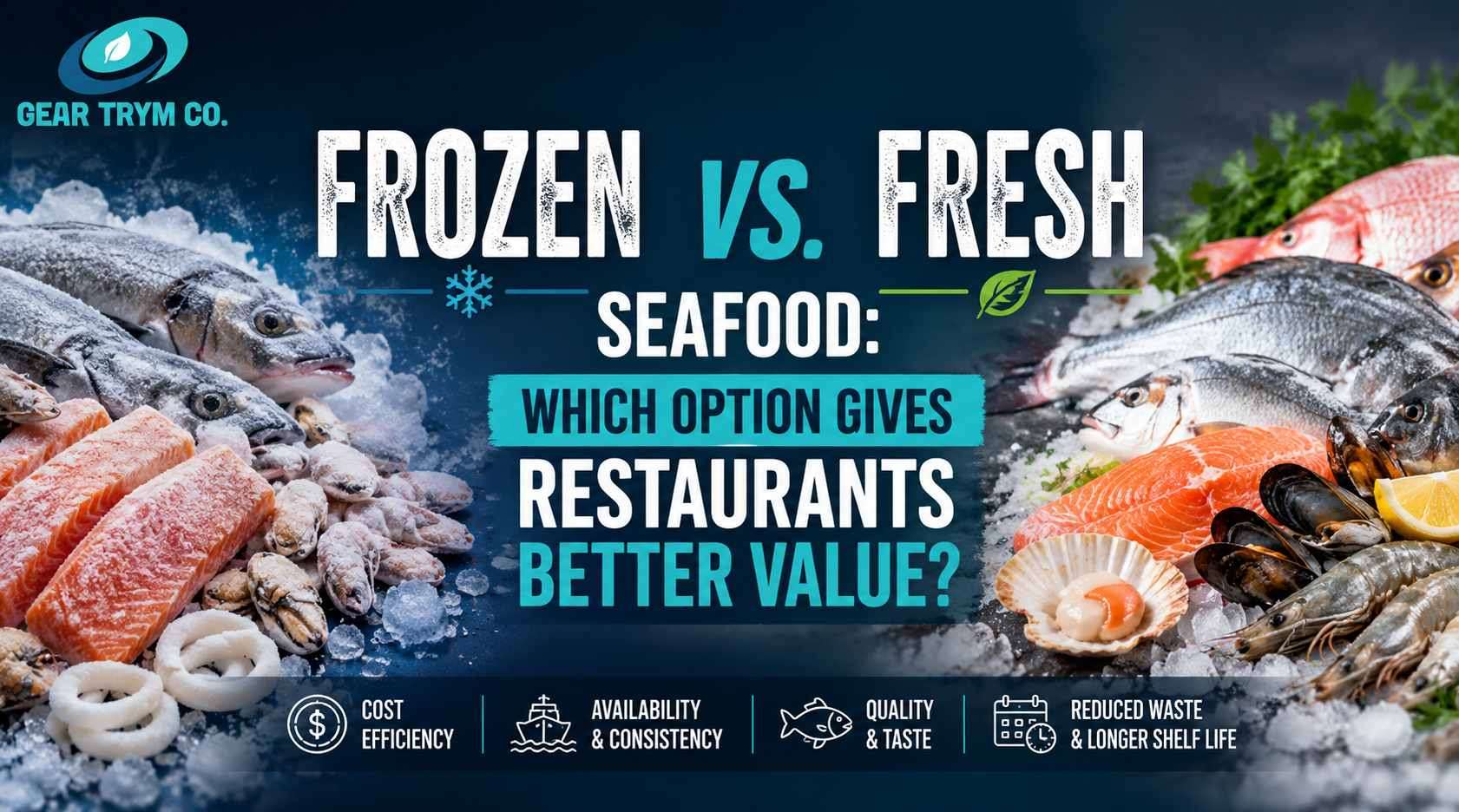
You are paying a premium for fresh seafood every week. But is it actually delivering premium value to your kitchen, or is it quietly eating into your margins one spoiled fillet at a time?
This is a question more restaurant owners and hotel procurement teams are asking right now, and for good reason. Overall food inflation continues to climb, with food-away-from-home costs rising significantly faster than food purchased at retail. Every dollar in your food budget carries more pressure than it did two years ago. And seafood, one of your most expensive proteins, sits right at the center of that pressure.
In the restaurant industry the conversation around frozen vs. fresh seafood for restaurants is no longer just about quality. Operational resilience, cost control, and and procurement decisions are all factors that become important under the realities of a high-volume kitchen. This guide breaks both options down across the metrics that matter to you: quality, cost, shelf life, supply reliability, and menu consistency.
Here is something your seafood supplier may not tell you upfront. The term "fresh" does not always mean the seafood was caught that day. In the restaurant industry, "fresh" often refers to seafood that simply has not been frozen.
That distinction matters enormously when you are running a procurement operation. That sparkling fillet on ice could have been out of water for days or even weeks before making its way to your kitchen, having journeyed thousands of miles and losing quality with every passing day. The label says fresh. The reality is considerably different.
This is because the journey from sea to store lasts several days, and if fish is not frozen immediately after being caught, it risks losing quality and taste during transit. Fresh fish must be kept chilled. However, once exposed to higher temperatures, it tends to degrade quickly.
Understanding this is the foundation of smarter seafood procurement for restaurants. Once you see fresh seafood for what it actually is within a commercial supply chain, the comparison with frozen becomes a much more level playing field.
The quality debate between frozen and fresh comes down to one question: at what point was the seafood's quality locked in?
Flash freezing, sometimes called super-freezing or blast freezing, refers to freezing seafood at extremely low temperatures, sometimes beyond -70°F. This locks in textures, flavors, and nutrients at peak freshness. It is superior to slow freezing because it moves seafood extremely quickly through the 32°F stage, when most ice crystals form and damage cell walls, meaning only very small crystals are formed.
The result? Frozen fish equals fresh fish nutritionally, and sometimes surpasses it. Fresh fish that has been sitting for days may actually lose water-soluble vitamins, while properly frozen fish maintains its nutritional profile.
Blind taste tests show that high-quality frozen seafood can offer freshness that rivals, or even surpasses, "never frozen" fish, provided it is managed well. That is not a marketing claim. It is the current scientific consensus on flash frozen seafood quality.
For your kitchen team, what this means practically is that a properly sourced frozen product, thawed correctly, will perform consistently on the plate. When properly thawed, the taste of high-quality frozen seafood is virtually indistinguishable from fresh. Consistency is something fresh seafood, by its very nature, cannot always guarantee.
Let us talk numbers, because this is where the frozen versus fresh debate gets settled for most procurement professionals.
Fresh seafood averages USD 9.43 per pound, which is significantly higher than the average price per pound for major animal proteins like chicken at USD 3.07, pork at USD 3.14, and beef at USD 6.42 per pound. That price gap does not shrink when you factor in the hidden costs of fresh procurement.
On average, restaurants waste between 4% and 10% of all food they purchase due to spoilage, leftovers, and other reasons. Seafood, as one of the most perishable items in your kitchen, consists of a major part of that figure. When you factor in hidden costs, the true cost of food waste is 1.5 to 2 times the ingredient cost alone.
A full-service restaurant loses over USD 50,000 per year in food waste, with approximately 12% of food purchases lost to spoilage, overproduction, and trim waste in kitchens without tracking systems.
Frozen seafood cost management in foodservice tells a different story. The economic case for frozen seafood lies in its affordability, availability, and longevity. Frozen options tend to be more affordable than fresh seafood, are available year-round, and carry a significantly longer shelf life. Bulk purchasing amplifies this advantage further, with lower per-unit pricing and far less exposure to spoilage loss.
Portion control is another aspect any restaurant owner must consider when doing a cost analysis. With frozen seafood, you are working with individually portioned, pre-weighed units. That means tighter yield management, less prep waste, and more predictable plate costs across every service.
Fresh seafood has a usable window of 1 to 3 days under perfect refrigeration. If you run a high-volume restaurant or a hotel kitchen managing multiple outlets, that window is narrow and will create difficulties for kitchen operations. You will need to be on your toes at all times. That means keeping your inventory filled by ordering more frequently, monitoring expiry dates closely, and absorbing losses when demand does not match supply.
Frozen seafood changes the entire kitchen workflow. When it is stored correctly, it can maintain its quality for an extended period. This gives restaurant owners a massive advantage, especially those who need to manage inventory efficiently. It allows you to offer a diverse and consistent menu throughout the year.
One of the most practical strategies for how to reduce seafood waste in commercial kitchens is shifting a portion of your seafood procurement to frozen. More than 80% of surplus food comes from perishables, which include seafood, meats, fruits and vegetables, and dairy. Reducing your dependence on highly perishable fresh stock directly reduces your exposure in the highest-risk category.
For hotel chains managing banquets, room service, and all kinds of dining formats simultaneously, frozen stock of seafood gives them the space to pre-position inventory without the anxiety of daily freshness checks. So your team spends less time on reactive stock management and more time on service.
Your guests expect the salmon dish to taste the same in January as it does in July. That expectation is hard to meet when your supply chain consists of fresh seafood. The quality of your seafood inventory in this case will depend on seasonal catch cycles, and weather disruptions. In short, the quality will vary widely and that is not a good thing.
Frozen fish products are available all-year round since they can be exported or imported internationally. Consequently, buyers are no longer restricted by local catch seasons or geographical limitations. This is the kind of advantage that fresh seafood simply cannot match at scale.
For frozen seafood wholesale supply for hotels and restaurants, the supplier relationship looks different too. You are working with larger, pre-planned order volumes, predictable lead times, and the ability to stock up ahead of high-demand periods like holidays, conferences, or peak tourist seasons. Your menu engineering team can plan with confidence because you know the product will be there.
Many sushi restaurants, from take-out stalls to the Michelin-starred, already take advantage of frozen seafood's benefits. In addition to convenience and year-round availability, high-quality frozen seafood allows kitchens to serve at peak flavor and texture while reducing bacteria and parasite risks.
The restaurant sector is highly competitive, and to beat the competiton you need to build a resilient procurement model. Your competitors are already doing that. If your current sourcing strategy leaves you scrambling during supply disruptions, then you need to adress that risk.
Fresh seafood is not without its place. There are specific menu applications where it remains the right decision.
One of them is live tank programs for lobster and crab, raw bars serving oysters and clams, and sashimi-grade tuna for high-end Japanese concepts all have legitimate requirements for product that has not been frozen. In these cases, the guest experience is built around the live or never-frozen attribute, and that attribute justifies the premium.
Coastal restaurant operations with direct relationships to local day-boat fishermen also have access to genuinely fresh product with very short supply chains. If your kitchen sits 20 miles from a working harbor and you have a trusted, direct supplier, fresh procurement makes geographic and commercial sense.
The "fresh is always better" belief will always stay relevant in the restaurant industry. Fresh seafood has a perception that is built by decades of traditional culinary dishes and cultural identity, along with marketing. But that perception does not always hold up against the numbers of a restaurant operations. And in a market where food inflation at restaurants has been running significantly higher than retail food inflation year over year, procurement decisions need to be grounded in evidence and not a favorable perception.
For the majority of restaurant and hotel foodservice operations, a well-sourced frozen seafood program delivers comparable quality, and far less operational risk than an all-fresh approach. That is not a compromise. That is a smarter way to run a kitchen.
Your suppliers are not going to bring this conversation to you. Your competitors who have already made the shift are not advertising it. The window to build a more resilient, cost-efficient seafood procurement model is open right now. The question is whether you are going to act on it.
Review your current seafood supplier relationships, request frozen samples, and run the numbers. The value is there. You just have to look for it in the right place.
You are paying a premium for fresh seafood every week. But is it actually delivering premium valu
READ FULLChicken is a perishable item and among the most demanded ones in the food industry. Restaurants,
READ FULL