




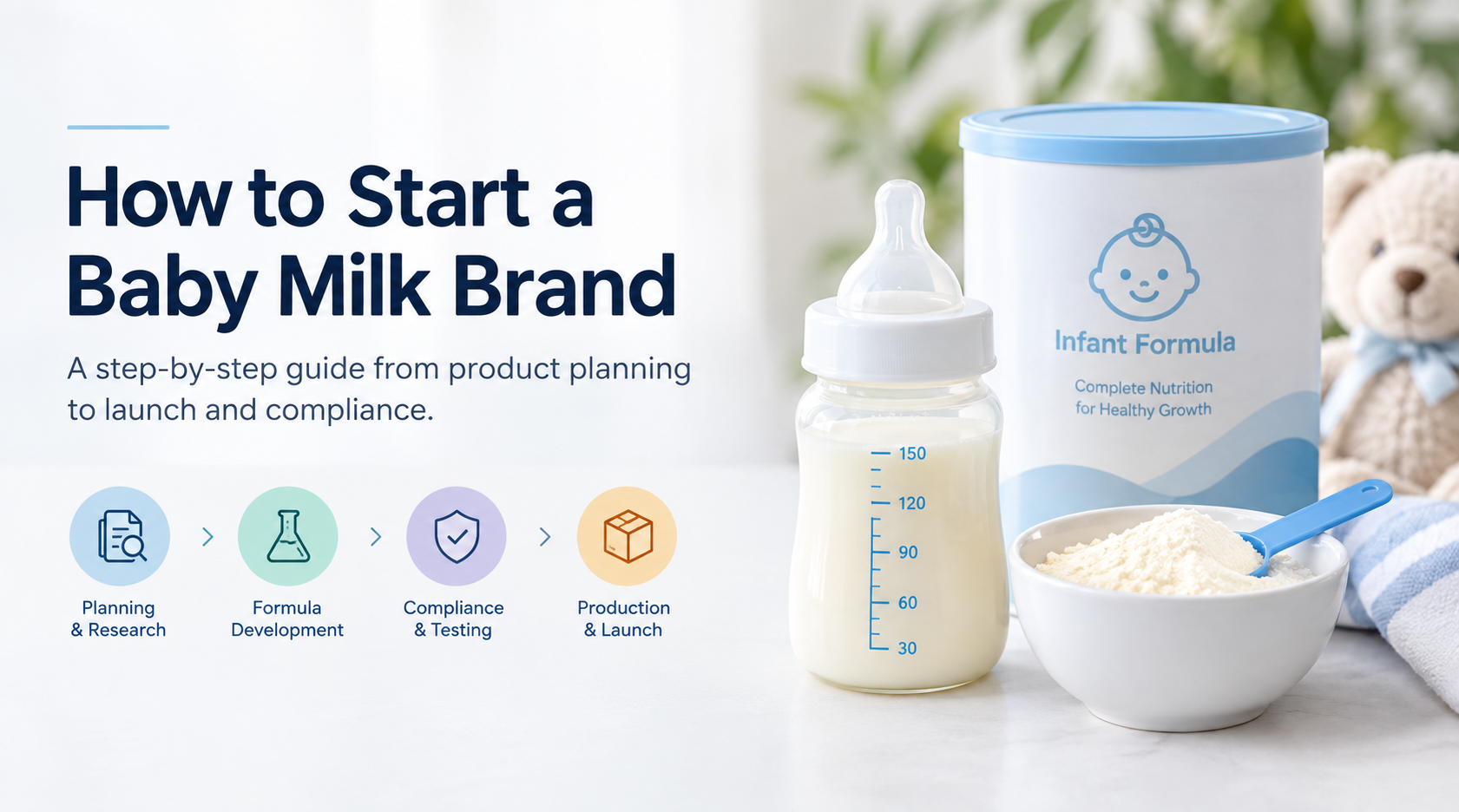
Starting a baby milk brand involves much more than developing a formula and putting a logo on a tin. Infant formula is a highly regulated product, and the requirements for formulation, manufacturing, testing, labeling, marketing, and distribution can vary significantly between countries.
For a new brand, the first decisions are often the most important. You need to determine what type of product you want to sell, where you plan to sell it, which regulations apply, and whether you should manufacture the product yourself or work with an experienced contract manufacturer.
You also need the right technical support. Food scientists, nutrition specialists, quality professionals, regulatory consultants, packaging specialists, and experienced infant formula manufacturers can each play an important role in the process.
This guide explains how to start a baby milk brand step by step. It covers product planning, formula development, manufacturer selection, regulatory requirements, testing, packaging, supply planning, distribution, and post-launch compliance.
Before discussing ingredients or packaging, define exactly what you intend to sell. “Baby milk” is a broad commercial term and may refer to different products depending on the market. Infant formula, follow-on formula, toddler milk products, specialty formulas, powdered products, and ready-to-feed products can have different requirements.
Your target market should also be established at the beginning rather than after the formula has been developed.
The intended age group and product category affect formulation, labeling, marketing, and regulatory requirements.
For example, a company developing a product for infants should not assume that the same formulation or label approach can be used for a toddler product. Specialty products may also have additional requirements depending on their intended use and composition.
Start by documenting:
This information gives your formulation and regulatory teams a defined starting point.
Regulations differ between jurisdictions, so choosing your market before finalizing the product is important.
Research the requirements that apply to:
If you plan to sell in several countries, do not assume that compliance in one market automatically means compliance in another.
Competitor research should go beyond looking at retail prices. Examine how established brands position their products and what buyers actually receive for the price.
Compare:
The goal is to identify a realistic market position rather than creating a product that simply copies an existing brand.
Formula development should be handled by professionals with appropriate experience in infant nutrition and food manufacturing. It is not an area where a new brand should rely on trial and error or attempt to reproduce another company's formula.
The development process should consider the nutritional requirements of the intended product category and the regulations of the target market.
The formulation team will need to determine the appropriate levels and sources of nutrients such as:
The exact formulation depends on the product category and applicable regulations. Ingredient selection should therefore take place alongside regulatory review rather than as a separate exercise.
An ingredient that is acceptable in one market may be restricted or subject to different conditions in another.
Before committing to large quantities, verify:
Supplier qualification is also important because the quality of the finished formula depends partly on the consistency of its raw materials.
Testing should begin during development rather than being treated as something that happens only immediately before launch.
Depending on the product and applicable requirements, development work may include nutritional analysis, microbiological testing, stability studies, ingredient verification, and other quality evaluations.
The objective is to demonstrate that the finished product consistently meets its defined specifications under the intended storage conditions.
For businesses planning to outsource production, it is useful to discuss testing requirements with the manufacturer before finalizing the formula. This can prevent a formulation from being developed without considering the manufacturer's equipment, processes, or quality-control capabilities.
One of the largest decisions for a new baby milk brand is how the product will be manufactured.
There are two broad approaches. A company can establish its own production operation or work with an experienced contract manufacturer.
Owning a production facility can provide greater control over manufacturing operations, production scheduling, equipment, staffing, and quality systems.
However, it also requires substantial investment and ongoing management. Depending on the market and product, the business may need suitable production equipment, qualified personnel, laboratory capabilities, sanitation systems, quality-control processes, environmental controls, documentation systems, and regulatory compliance programs.
For a new company, these requirements can make an in-house facility a significant financial and operational commitment.
Contract manufacturing can allow a new brand to access an established production facility without building the entire manufacturing operation itself.
This can be particularly useful when the company has limited capital or wants to concentrate on product development, branding, sales, and distribution.
However, outsourcing production does not mean outsourcing responsibility for making appropriate business and compliance decisions. The brand owner still needs to understand the applicable regulatory obligations and establish clear responsibilities with the manufacturer.
Before signing an agreement, clarify:
A written agreement should clearly define what each party is responsible for.
Choosing the right manufacturing partner can have a major effect on product quality, launch timing, and long-term supply.
Price should be considered, but it should not be the only deciding factor. A manufacturer offering a lower quotation may not provide the technical support, quality systems, production capacity, or documentation that your product requires.
Ask whether the manufacturer has experience producing products in the same category as yours.
Infant formula production requires specialized processes and controls. Experience with unrelated powdered foods does not necessarily demonstrate experience with infant formula.
Ask about:
Request current documentation for relevant certifications and quality systems. Do not rely solely on logos displayed on a website.
You should understand what each certification covers, who issued it, whether it is current, and whether it applies to the facility and production activities relevant to your product.
Where appropriate, ask to review supporting documentation during supplier qualification.
A manufacturer may be able to produce your initial order but struggle when demand increases.
Discuss expected volumes at the beginning of the relationship. Ask about:
This is particularly important for brands that expect to enter several markets or secure large distribution agreements.
Find out which tests are performed internally and which are outsourced to qualified laboratories.
You should also understand how batches are reviewed before release and what documentation is provided for each production run.
A clear batch-release process provides a stronger basis for product traceability and quality management.
For businesses considering [private label baby formula manufacturing], the manufacturer should also explain which parts of formulation, packaging, labeling, and documentation they can support.
Regulatory planning should begin before the first commercial batch is manufactured.
The specific requirements depend on the destination market and the product category. In the United States, for example, infant formula is subject to specific federal requirements administered by the U.S. Food and Drug Administration. Other countries and regions have their own rules and regulatory authorities.
Find out which registrations, notifications, submissions, or approvals apply to your business and product.
This may involve requirements relating to:
Do not rely on a generic checklist because requirements can differ according to the market and product.
The formulation should be reviewed against the requirements applicable to the intended market.
This includes checking nutrient specifications, permitted ingredients, preparation requirements, and any other applicable technical standards.
Regulatory review should happen before the formula and packaging are finalized. Changing a product after large-scale production or printing can create unnecessary costs and delays.
Marketing claims require particular care for infant and young-child products.
Do not assume that a statement is acceptable simply because a competitor uses similar wording.
Review proposed claims relating to:
Claims should be supported by appropriate evidence and permitted under the rules of the target market.
Packaging serves two purposes. It protects the product and communicates information required by the customer and applicable regulations.
The packaging format should be selected with the product's physical characteristics, storage conditions, distribution environment, and shelf life in mind.
For powdered formula, protection from moisture and environmental exposure is particularly important.
Depending on the product, packaging evaluation may include:
Packaging should be evaluated before committing to large production quantities.
A regulatory review should be completed before final artwork is approved.
The exact label requirements depend on the destination market, but the review may include:
A label that looks attractive but contains incorrect or incomplete information can create serious compliance and commercial problems.
This is why [baby formula packaging] should be treated as part of product development rather than as a final branding exercise.
Finished-product testing helps confirm that the commercial product matches its specifications and remains suitable throughout its intended shelf life.
Testing requirements vary by product and market, so the testing program should be established with qualified technical and regulatory professionals.
Infant formula requires careful microbiological control. Testing is one component of a broader food-safety system that should include sanitation, environmental controls, process controls, raw-material controls, and appropriate manufacturing practices.
Testing alone does not make a manufacturing process safe. It works alongside preventive controls and quality-management procedures.
Nutritional testing can be used to verify the composition of the finished product against its specifications.
The manufacturer should have a defined process for reviewing test results and determining whether a batch can be released.
Stability studies help establish how the product behaves during its intended shelf life under defined storage conditions.
These studies can provide information about changes in nutritional composition, physical characteristics, microbiological quality, packaging performance, and other relevant product attributes.
Shelf-life claims should be based on appropriate evidence rather than assumptions.
Finished packaging should also be evaluated for seal integrity and other characteristics that could affect product protection during storage and transportation.
A product may meet its formulation specifications but still encounter problems if the packaging does not adequately protect it.
A successful product launch requires more than having a formula and a manufacturer. You also need a reliable supply plan.
Ingredient shortages, packaging delays, long production schedules, and inaccurate demand forecasts can all affect availability.
Work with the manufacturer to identify critical ingredients and packaging components that could create supply bottlenecks.
For important materials, evaluate:
Any proposed alternative ingredient should go through the appropriate technical and regulatory review before being used.
Minimum order quantities can have a significant effect on startup cash flow.
Before placing an order, calculate the relationship between:
A low unit price is not necessarily economical if the required order quantity creates excessive inventory.
Keep appropriate records for raw materials, production batches, finished products, and distribution.
Traceability becomes particularly important if a quality complaint or product withdrawal occurs. Your business should be able to identify affected batches and determine where they were distributed.
Your distribution strategy should match the market, customer profile, product positioning, and available working capital.
A new brand may begin with a limited number of channels rather than trying to enter every type of retail outlet immediately.
Potential channels can include:
The suitability of each channel depends on the market and applicable rules.
A distributor can provide access to established retail networks, but the arrangement affects your pricing and margins.
Before signing a distribution agreement, understand:
The distributor should also understand the importance of storing and handling the product according to the applicable requirements.
Launching with a manageable initial production run can give a new company an opportunity to test its supply chain and operational systems before significantly increasing volume.
Before launch, confirm that the following are ready:
The launch should also be supported by marketing materials that accurately describe the product and stay within the rules applicable to the target market.
Avoid making claims that have not been properly reviewed simply because they may make the product sound more attractive.
Regulatory responsibility does not end when the first shipment leaves the factory.
A baby milk brand needs systems for maintaining product quality and responding to issues throughout the product's commercial life.
Establish a documented process for receiving, reviewing, investigating, and responding to product complaints.
Complaints should be assessed to determine whether they indicate an isolated issue or a broader quality problem.
Keep appropriate records that connect raw materials, manufacturing batches, finished products, and distribution.
Good traceability allows a company to identify potentially affected products more quickly if a quality issue occurs.
Supplier qualification should not be treated as a one-time activity.
Review important suppliers and manufacturing partners periodically based on their performance, quality records, changes in operations, and other relevant factors.
Changes to ingredients, suppliers, packaging, manufacturing processes, markets, or regulations may require documentation or label review.
Maintain controlled versions of product specifications, labels, technical documents, and other important records so outdated information does not enter production or distribution.
Starting a baby milk brand requires careful planning across formulation, regulatory compliance, manufacturing, testing, packaging, supply, distribution, and ongoing quality management. The process becomes easier to manage when these areas are addressed before commercial production begins rather than after problems appear.
Start by defining the exact product and target market. Then work with qualified specialists to develop and review the formula, select a manufacturing model, and evaluate potential manufacturers based on technical capability rather than price alone. Before launch, verify the applicable regulatory requirements, test the finished product, review the packaging and labeling, and establish reliable systems for traceability and complaints.
For a new brand, an experienced contract manufacturer can provide valuable production and technical support, but choosing the right partner requires careful due diligence. A manufacturer with appropriate infant formula experience, quality systems, testing capabilities, production capacity, and documentation can help turn a product concept into a commercially viable brand while supporting the quality and compliance requirements that come with this highly regulated category.
You are paying a premium for fresh seafood every week. But is it actually delivering premium valu
READ FULLChicken is a perishable item and among the most demanded ones in the food industry. Restaurants,
READ FULL